
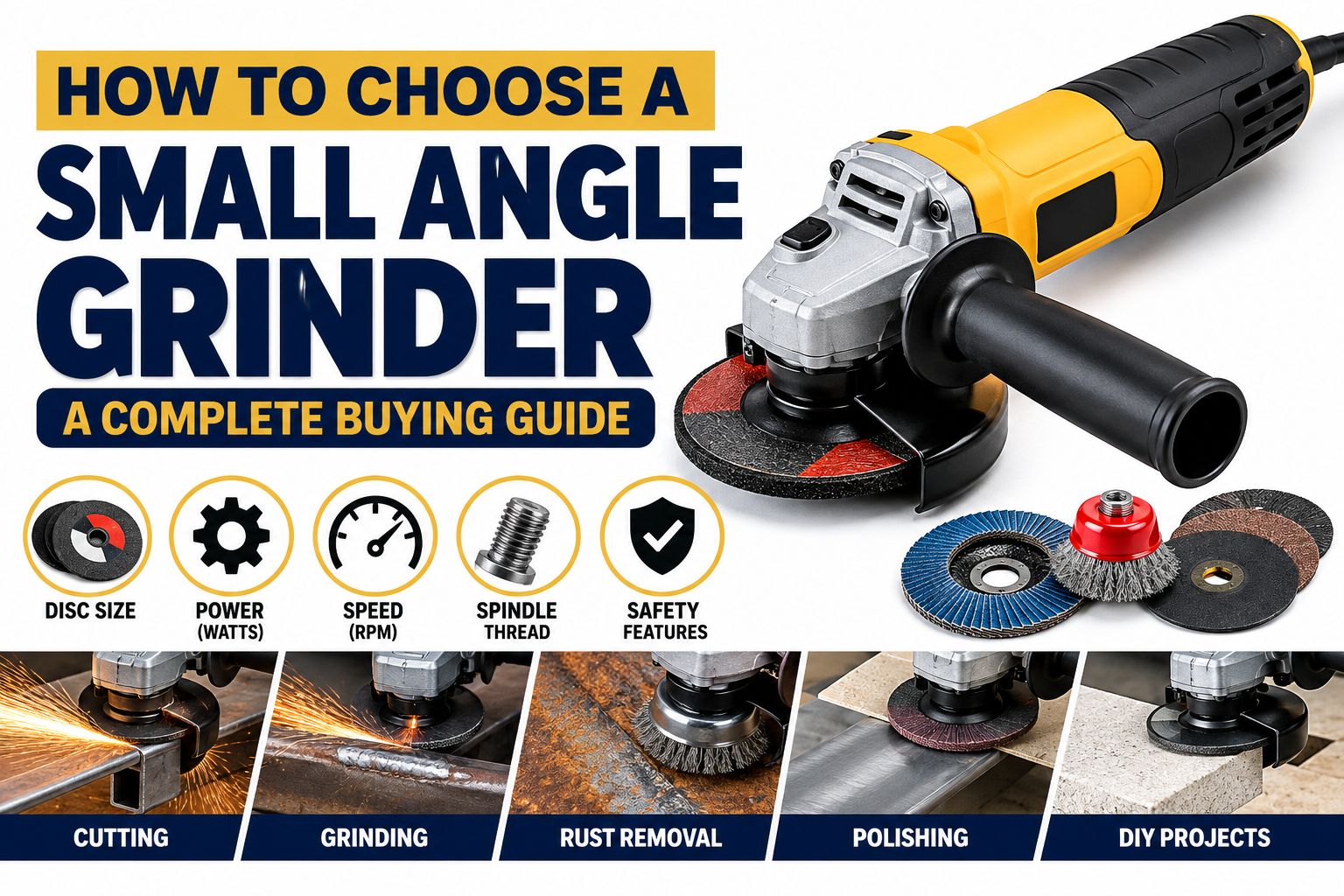
How to Choose the Right Small Angle Grinder: A Complete Buying Guide Leave a comment
A small angle grinder is one of the most useful power tools for cutting, grinding, polishing, and surface preparation. Whether you are a professional fundi, welder, carpenter, metalworker, or a DIY enthusiast, choosing the right grinder can make your work faster, easier, and safer.
With different brands, power ratings, disc sizes, speeds, and features available, it can be difficult to know which small grinder is right for your needs.
In this guide, we explain the most important factors to consider when buying a small angle grinder.
1. Consider the Grinder Disc Size
One of the first things to check is the disc size.
Small angle grinders commonly use 4-inch, 4.5-inch, or 5-inch discs. The disc size affects the type and depth of cutting and grinding you can perform.
4-inch to 4.5-inch grinders
These are suitable for:
Light metal cutting
Grinding welds
Removing rust
Sharpening metal
Small fabrication jobs
DIY projects
General workshop use
For many household and light workshop applications, a 4-inch or 4.5-inch grinder provides a good balance between size, control, and performance.
2. Check the Motor Power
Motor power is another important factor when choosing a grinder.
Small grinders can have different wattage ratings, such as 700W, 900W, 1100W, 1200W, and higher.
A higher wattage generally means the grinder has more power available for demanding applications. However, more watts do not automatically mean that a grinder is the best choice for every job.
For example:
700W–900W: Suitable for lighter work and occasional use
900W–1100W: Good for general workshop and metalworking applications
1100W and above: Better suited to heavier and more demanding work
Choose the power level according to the materials and amount of work you expect to handle.
3. Look at the No-Load Speed
The no-load speed tells you how fast the grinder’s disc rotates when the tool is running without cutting or grinding a material.
It is usually measured in RPM (revolutions per minute).
A small angle grinder may have a no-load speed of around 8,000–12,000 RPM, depending on the model.
Higher speed can be useful for certain grinding and cutting applications, but you should always use a disc that is rated for the grinder’s operating speed.
Never use a disc with a maximum RPM rating lower than the grinder’s speed.
4. Check the Spindle Thread
The spindle thread is important because it determines which accessories can be fitted to the grinder.
Many small angle grinders use an M14 spindle thread, although specifications can vary between models.
Before purchasing accessories such as grinding wheels, cutting discs, polishing pads, or wire brushes, check that they are compatible with your grinder.
5. Consider the Type of Work You Will Do
Think about what you actually want to use the grinder for.
For metal cutting
Choose a grinder that is powerful enough for your materials and use the correct cutting disc.
For grinding welds
Look for a durable grinder with sufficient power for continuous workshop use.
For rust removal
A grinder compatible with wire wheels or suitable abrasive accessories can be useful.
For polishing
Make sure the grinder supports the appropriate polishing accessories and operating speeds.
For DIY work
A compact grinder with moderate power can be easier to handle and transport.
6. Consider the Weight and Size
A small grinder should be comfortable to hold, especially when working for extended periods.
A lightweight and compact design can provide better control when working in tight spaces.
However, an extremely lightweight grinder may not always be the best option for heavy-duty applications.
Look for a balance between power, weight, comfort, and durability.
7. Check the Safety Features
Safety should always be considered when buying and using an angle grinder.
Useful features can include:
Protective disc guard
Side handle
Spindle lock
Easy-to-operate switch
Overload protection on some models
Good ventilation and cooling
Always wear appropriate personal protective equipment, including safety glasses or a face shield, hearing protection, gloves where appropriate, and suitable work clothing.
Make sure the disc guard is correctly installed and use the correct accessory for the job.
8. Corded or Cordless Grinder?
Small grinders are available in both corded and cordless versions.
Corded grinders
Advantages include:
Continuous power supply
No battery charging
Suitable for longer work sessions
Often suitable for workshop use
Cordless grinders
Advantages include:
Easy to carry
No power cable
Useful where electricity is unavailable
Convenient for jobs on different sites
If you choose a cordless grinder, check the battery voltage, number of batteries included, charging time, and battery availability.
9. Choose a Reliable Brand
The brand can also be an important consideration.
Look at the manufacturer’s specifications, warranty, availability of spare parts, accessories, batteries, and after-sales support.
Instead of choosing a grinder based only on price, compare the power, speed, disc size, build quality, included accessories, and warranty.
10. Don’t Forget the Accessories
The grinder itself is only part of the setup.
Depending on your work, you may need:
Cutting discs
Grinding discs
Flap discs
Wire wheels
Polishing pads
Sanding discs
Additional side handles
Replacement guards
Always make sure the accessory is designed for your grinder and the specific application.
What Size Small Grinder Should You Buy?
For general household, workshop, and metalworking applications, a 4-inch or 4.5-inch angle grinder is a practical choice.
If you regularly work with heavier materials, you may want to consider a more powerful grinder or a larger model.
The right choice ultimately depends on the type of work, frequency of use, material being worked on, and accessories required.
Final Thoughts
Choosing a small angle grinder doesn’t have to be difficult. Start by identifying the jobs you want to perform, then compare the disc size, motor power, RPM, spindle thread, weight, safety features, power source, and available accessories.
A good grinder should provide enough power for your work while remaining comfortable and easy to control.
If you are looking for a small angle grinder in Kenya, you can compare different models based on your budget and intended application before making your purchase.
